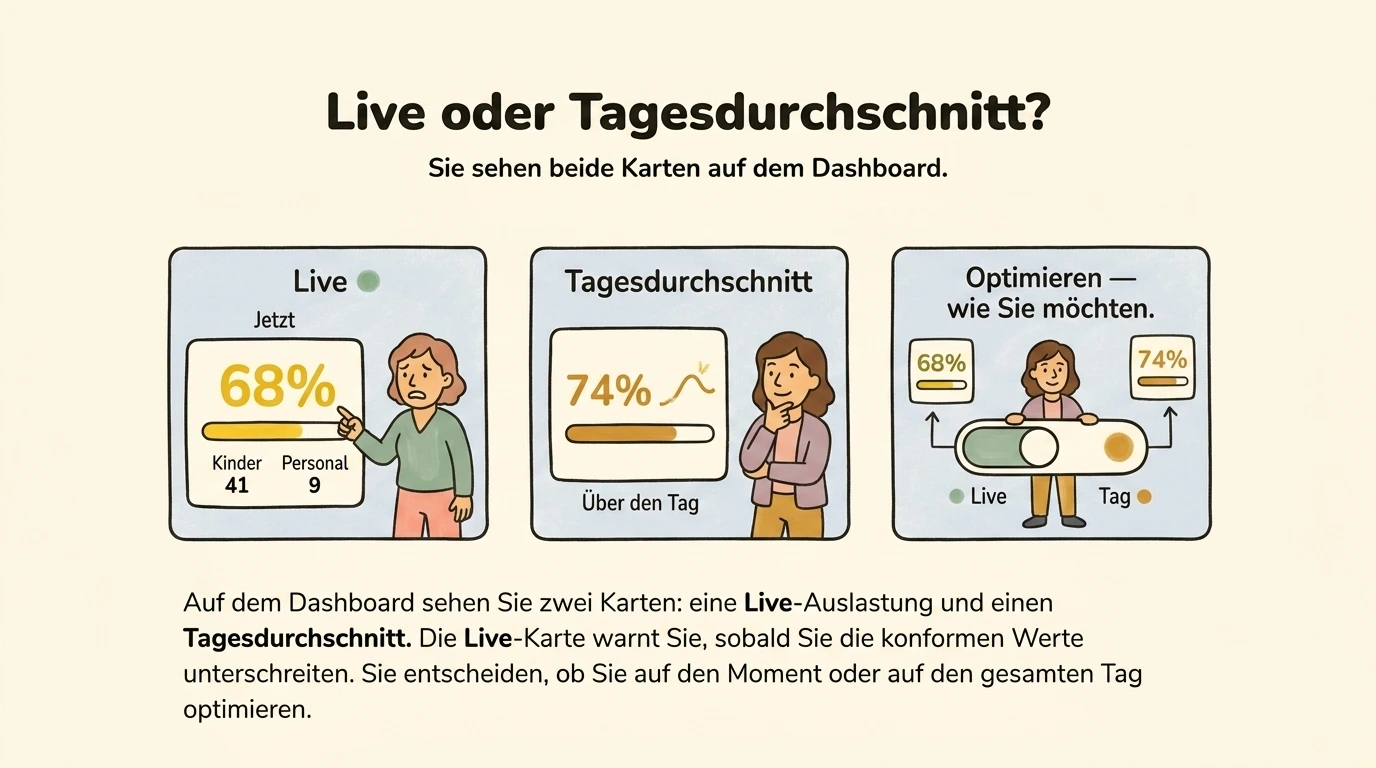
§ 45 SGB VIII only requires an operating licence. Granularity sits in the state KiTaG and in how the office audits: Bavaria often an annual mean, Rhineland-Palatinate daily. Statutes usually accept day, week or month. An incident is judged by the minute.
Two paths: stay live, or document at the tier your state requires. Bienenstock stores presence immutably. Reports for any period remain available, whichever path you pick.
Updated 2026-05-27
Two paths
Stay live, or smooth over a period
You can mix by area: nursery tighter, after-school looser. The live ratio can run everywhere.
Live
Recommended
Ratio from check-in, every second. Below 1.0 is green. One-off setup: children and staff scan.
Monthly, weekly and daily assessment is covered automatically.
Two-specialist rule and supervision in the exact minute.
Early warning before it gets tight.
Day, week, month
You document at the tier the state asks. Swings average out. The two-specialist rule and supervision still apply at every moment.
More flexibility around bridge days, training and closures.
Mirrors annual and quarterly means in many states.
Less recording in day-to-day work.
Live is the shorter day: no evening tally. Children have staff where the ratio requires it. Periodic needs more planning from leadership.
When it gets tight
Five levers in the same app
It rarely gets this far: live makes planning tighter. If it does, the same tools apply.
Switch mode
Temporarily hourly or daily optimisation, with an audit trail.
Warn parents
Alert when a bottleneck approaches, including early pickup.
Switch booking
At check-in, full-day to half-day: demand drops immediately.
Free slots
Parents see when occupancy comes down again.
Traffic light
Green, yellow, red for drop-off timing.
Either path
Other rules still run
Not only the ratio. Bienenstock sets thresholds to your state.
Two-specialist rule and minimum presence
Specialist quota over the reference period
Max group size per age mix
Age limits (e.g. infants in nursery)
Specialist-to-assistant ratio
Audit
Routine is coarse, an incident is fine
Without a trigger, the staffing plan and a monthly report almost always suffice. Accident, complaint, insurance: “What happened on 14 March between 11 and 12?” Means alone have no answer. Live covers the statutory tier and the minute.
Excel for any period, data only for your facility, GDPR. Keep a local copy if you want.
Daily work
What live changes in the group
Staff where demand is
Cover and breaks from the ratio, not from gut feel.
More calm for children
Leadership spends less time on ratio puzzles.
Parents see occupancy
Less friction at drop-off.
Patterns early
Peaks weeks ahead, not after the fact.
FAQ
Is an Excel sheet with a monthly balance enough for the operating licence?
For routine operation, usually yes: youth welfare typically spot-checks monthly or quarterly reports under § 45 SGB VIII. In an incident, claim or complaint, what you can reconstruct backwards is what matters.
Which states accept monthly averages instead of daily figures?
Brandenburg (quarterly), Berlin (specialist quota quarterly), Bavaria (annual mean of the Anstellungsschlüssel), Saxony (monthly funding reports). Hamburg, Hesse and NRW assess weekly; Rhineland-Palatinate, Lower Saxony and Saarland daily. See each state page.
When is daily compliance still risky despite statutory adequacy?
When a concrete supervision moment fails: lunch, handover, opening and closing. The daily mean can look fine while that minute was understaffed. Supervision duty (§ 832 BGB) and insurance are judged on the minute of the incident.
What does "live" mean in an audit context?
Not a live stream for the authority. It means you can reconstruct, for any minute of operation, who was present and what the ratio was. No statute requires that granularity; it is the one that holds in a dispute.
Can I combine the two approaches per area?
Yes. Nursery is supervision-critical and should be at least daily. After-school care is weekly in some states. The live ratio can run everywhere; reports follow the granularity you choose per area.
How much extra effort does live documentation cost?
None extra, often less. Check-in/out runs in the background. The facility is never over-occupied. Periodic documentation creates follow-up work whenever planned and actual diverge.
How long do I have to keep documentation?
Personnel files often 10 years after employment ends. Funding evidence follows state budget rules (often 5–10 years). Supervision evidence as long as claims remain possible. Confirm periods with provider and insurer.
What happens during a spot check without live data?
First the staffing plan, occupancy and attendance. If monthly or weekly reports suffice, the check often ends. With a concrete trigger, the day is requested. Bienenstock stores presence immutably. Live as a path means real-time compliance, not only later retrieval.